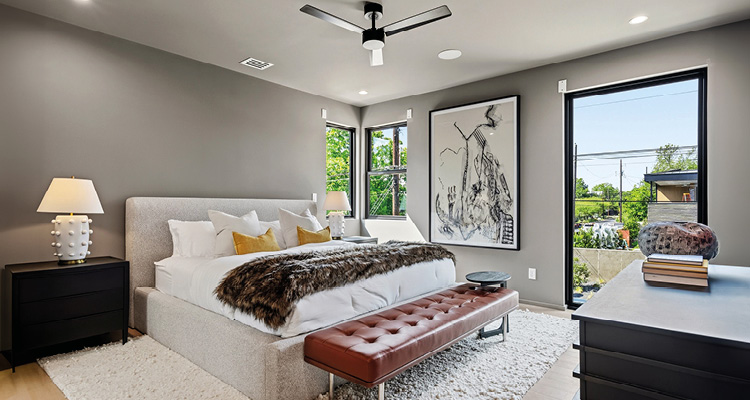
Vertically integrated and design-led, Joseph Design Build brings luxury and affordability to Austin’s ‘missing middle’ market
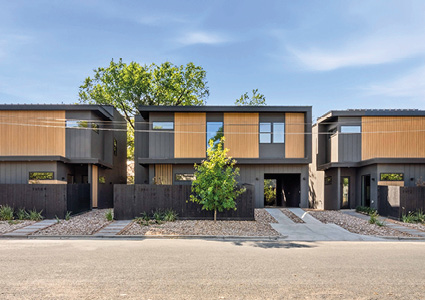
Up until two years ago, Joseph Design Build was in the business of crafting architectural homes ranging from $3 million to $6 million – bespoke, high-end infill projects in Austin’s desirable downtown-adjacent neighborhoods. Then the city changed the rules. When Austin began permitting two or three homes on lots that had previously allowed just one, it meant that developers were able to construct more homes at more affordable price points, instead of building a handful of multi-million-dollar houses.
For many builders, that would mean scaling back ambition to hit a lower price point. However, for Joseph Design Build – co-founded by brothers Gabe and Thomas Joseph in 2012 – it raised a different question entirely: could the same architectural precision and design quality that defined their luxury work be brought to a more affordable price point? “As a vertically integrated design-build firm focused on infill housing, we’re specifically addressing the missing middle housing shortage in Austin,” explains Thomas. “We have a team of just over 60 people here in Austin, and we’re the full stack – we do everything ourselves: acquisition of the properties, in-house architecture and engineering, procurement, production, marketing, and sales.
Transforming neighborhoods
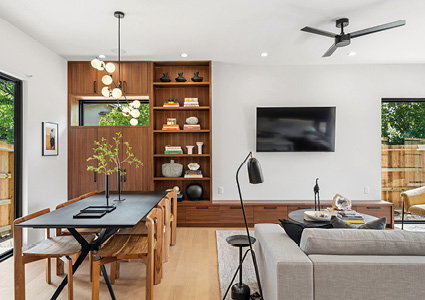
To date, the group has completed over 90 homes in Austin and currently has 182 in process, with one additional project in Dallas. “Several of the neighborhoods five minutes from downtown were built in the 1940s and 1950s with very old housing stock and we’re redeveloping those into modern luxury homes,” he says. Following the city’s rule change around building lots, most of Joseph Design Build’s developments now sit in the $750,000–$1,500,000 range, which Thomas describes as “effectively entry-level” for Austin. “Many people simply cannot afford multi-million-dollar homes, especially with interest rates as high as they’ve been,” Thomas continues. “Our thinking was: can we lean into the creative design side we love and bring it to those who ordinarily couldn’t afford contemporary design, custom home details, and cutting-edge technology, at a price point they can reach? That’s the business and the mission.”
Smart solutions
The infill home builds that Joseph Design Build specializes in sit between production building and custom home building; still within the city, situated in existing neighborhoods which usually means demolishing an older home and starting fresh. “It’s a genuinely complicated form of building,” Thomas acknowledges. “You’re more constrained with houses on either side of you, your sites are spread across the city rather than concentrated, and you also face far more zoning and permitting constraints but it’s where housing is most needed.
“In Austin, for example, there are strong environmental protections, varied site conditions and sites scattered throughout the city. However, you’re building in neighborhoods with very high demand, for people who don’t want to live 30 minutes out in the suburbs, but who aren’t ready to spend millions building something custom. Infill housing solves that problem.”
Setting it apart from competitors, Joseph Design Build’s high-quality modern homes boast space efficiency, well-lit houses and biophilic design; using landscaping to create views through windows. Externally, it uses materials less likely to deteriorate in the Texas heat and, when it comes to technology, the firm offers smart homes with appliances that can be controlled via phone, including video doorbells, thermostats, built-in speakers, automated blinds, and lighting.
Buyer profiles
Delivering infill housing in Austin is helped significantly by the city’s pro-development attitude, recognizing early on that there was a housing shortage and that people working in the downtown urban core needed a solution. Thomas credits Austin with being “one of the more progressive cities on missing-middle housing,” highlighting how much the city is doing to enable the housing supply and affordability people desperately need. “Texas has also passed state-level legislation supporting this housing type, and many other states are following. I’m proud to say Austin is at the forefront of this shift.”
Another key element is how the firm imports finished materials yet builds the structural core locally – a split that enables Joseph Design Build to deliver high-quality finishes while still hitting the price points people need. “We realized that by going directly to quarries and manufacturers for stone, tile and countertops, then shipping and warehousing that material ourselves, we can bring costs down enough to put higher-end materials into more approachable homes. That factory-direct, quarry-direct approach has been a real differentiator,” notes Thomas.
With a product starting at around $700,000 and an average price of just over $1 million, the company’s typical client profile is roughly 70 percent ‘empty nesters’ and 30 percent of buyers in their thirties. “A large percentage of our clientele is 55-plus; their kids have moved out, and they no longer need the space of a large suburban house, but they want to be near their city’s amenities,” adds Thomas. “They’re not typically retired – they’re in the last few years of their working life – but they want an urban lifestyle and to be closer to the action.” He believes one factor behind the empty-nester skew is the absence of state income tax in Texas. “About 90 percent of our buyers come from New York or California, often working in fields like tech and financial services, where they can work remotely and relocate for the tax savings.” The younger buyers normally work downtown, often in tech, without children and on a dual income. “They’re trading size for location and lifestyle,” he observes. “The location of our houses allows them to walk to coffee shops, restaurants and music venues.”
Proof of concept
Thomas and Gabe aligned with new partners around 18 months ago to fund the company’s expansion who agreed on the scalability of the missing middle market and shared the founders’ belief that outstanding design shouldn’t just be reserved for custom homes. The excellent results of this collaboration are shown in recent projects, such as 1912 South 3rd Street. Due to complete within weeks [at time of writing], Thomas says a significant project and proof of concept for everything that comes next. “Our goal is to go public or sell within four years,” reveals Thomas. “We’re in growth mode, aiming to reach 250 homes a year. We’re already established in Austin, currently undertaking our first project in Dallas, and looking next at moving into Nashville, Raleigh and Seattle. We want to expand our missing-middle product with first-rate design nationally.”