
The Revenue Opportunity Custom Builders Are Missing: How Financing Partnerships Drive Larger Projects in 2026
Many contractors have experienced this scenario — a client loves the nearly completed home, but hesitates when presented with the outdoor living package that would complete the vision. The project stalls or scales back dramatically, and the builder watches high-margin revenue disappear. However, builders are increasingly discovering that strategic financing partnerships can overcome hesitancy and help buyers say yes to the dream.
The Market Reality and Hidden Revenue Leak
Data from the National Association of Home Builders and Wells Fargo shows the market index fell to 34 in July from 36 in June, marking 15 consecutive months below 40. 37% of builders cut prices in July just to keep projects moving.
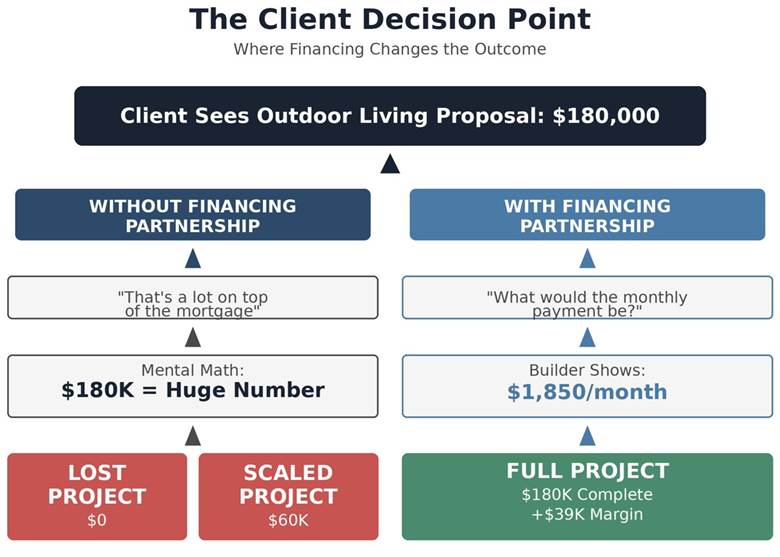
A builder presents a complete outdoor living package – pool with integrated spa, premium decking and hardscaping, outdoor kitchen with fire feature and landscaping totaling $180,000. The response is predictable. “We love it, but that’s a lot on top of the mortgage. Let me think about it.”
That thinking typically leads to scaling way back, delaying indefinitely or finding a cheaper contractor. Clients struggle to understand the best way to pay for a new pool when faced with substantial numbers. The builder just watched $180,000 in margin-rich work turn into “maybe later.” With 67% of builders reporting slower-than-expected demand in Q2 2026, the pressure mounts.
The Partnership Model That’s Changing the Conversation
A growing number of builders have found that financing converts hesitant clients into committed buyers. The first half of 2026 brought significant movement in builder-lender partnerships. LoanDepot launched an expanded partnership channel in March. CrossCountry Mortgage followed, aligning more closely with builders through a dedicated builder division.
These examples signal that builders need financial partners as much as trade partners. When homeowners wonder if personal loans are a good idea for financing a pool, the answer depends on having the right partner to guide the decision.
The difference is clear. Traditional approaches have builders presenting total costs and waiting while clients figure out financing themselves — often losing to price objections. Strategic partnerships let builders present monthly payment scenarios during initial conversations. When clients see “$1,850/month” instead of “$180,000,” the decision shifts from “Can we afford this?” to “Does this fit our monthly budget?”
CrossCountry Mortgage CEO Ron Leonhardt explains, “[The builder division] is designed to support both builders and CCM loan officers, giving builders a reliable mortgage partner and helping loan officers win more purchase business tied to new construction, without taking over their relationships or deals.”
The Psychology Behind the Shift
With 30-year mortgages at 6.3%, even affluent homeowners with substantial equity choose to preserve liquidity. They finance things they could pay cash for because money has opportunity cost. A financing partner who understands this shift becomes a sales asset.
For pool and outdoor living projects specifically, this shift has created a specialized niche. While traditional lenders focus on home mortgages, companies like Lyon Financial have built their entire model around financing these high-value outdoor amenity projects.
How Pool Financing Specifically Drives Larger Projects
Joe Garcia, National Sales Director at Lyon Financial, frames the impact simply. “Financing is more than getting a loan approved. It shapes how the customer understands the project and whether they feel comfortable moving forward.”
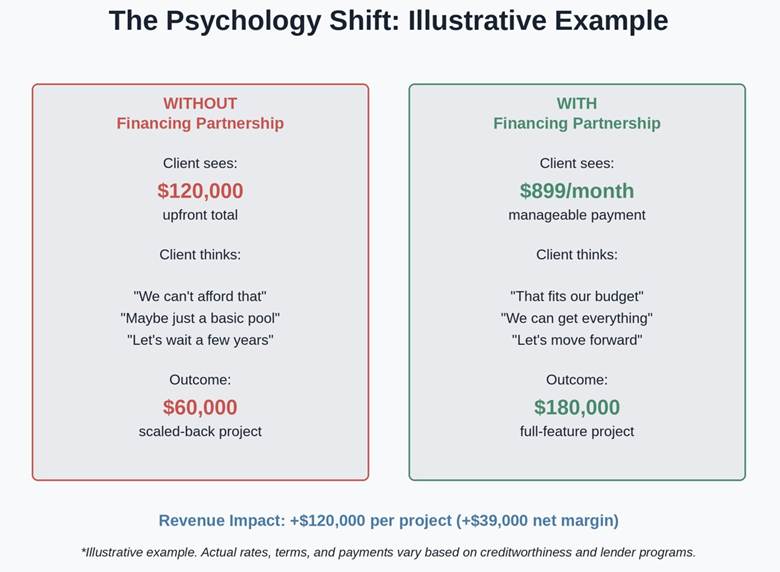
When a builder presents a $180,000 outdoor living package as a set monthly figure, the client’s mental calculation changes entirely. The question becomes less about which types of swimming pool loans are available and more about how to proceed with the project.
“When financing makes additional outdoor living features more affordable, it becomes easier for customers to commit to a complete backyard instead of settling for a basic pool and minimal decking,” explains Garcia.
The Revenue Impact
The numbers demonstrate the opportunity.
| Scenario | Client Decision | Builder Revenue | Builder Margin |
| Without financing partnership | “Let’s start with just a basic pool, maybe $60K.” | $60,000 | ~$15,000 (25%) |
| With financing partnership | “Let’s do the complete package, financed at $1,850/month.” | $180,000 | ~$54,000 (30% on high-margin outdoor work) |
The net difference reaches $39,000 in additional margin per project. If a custom builder completes 12 homes per year and half of those clients want outdoor living spaces, that equals six opportunities. At $39,000 additional margin per project, the total reaches $234,000 in additional annual margin.
Because full backyard financing covers outdoor kitchens, landscaping and pergolas as well as the pool, Garcia notes, “There’s peace of mind [for the client] knowing it’s more efficient to have one loan.”
What to Look For in a Financing Partner
Multiple factors matter when evaluating financing partners for outdoor living projects:
- Approval speed and prequalification: Can clients get prequalified without affecting their credit score? A prequalification process like Lyon Financial’s reduces fear and keeps momentum going.
- Loan structure: Unsecured loans offer faster approvals than secured home equity products. Lyon Financial offers terms of up to 15 years, making monthly payments manageable for six-figure projects.
- Builder support: Does the partner provide payment calculators for proposals, train the sales team on financing conversations and offer a direct builder portal for tracking applications?
- Industry specialization: A lender who finances pools year-round understands seasonal timing, contractor draw schedules and project milestone requirements.
- Homeowner experience: Garcia points to the “fee blind spot” among builders. “Builders often overlook how financing fee structures, approval speeds and draw management impact project flow and client satisfaction.”
Integrating Financing Into the Sales Process
To build financing partnerships into the sales process, contractors can:
- Identify their financing partner before peak season. For pool and outdoor living work, specialized lenders like Lyon Financial understand project-specific needs.
- Offer prequalification early in the design phase so financing becomes an enabler rather than a barrier.
- Show “Option A: $180,000 total / Option B: $1,850/month” side by side in written proposals.
- Track conversion rates to measure how many “thinking about it” clients convert when financing appears in proposals.
Frequently Asked Questions
Some key questions can make the advantages of a partnership clear.
Why does the monthly payment presentation change client decisions?
Presenting financing options reframes the conversation from “Can we afford $180,000?” to “Does $1,850 fit our monthly budget?” Clients make budget decisions based on monthly cash flow.
What advantage do specialized pool lenders offer over traditional home improvement loans?
Specialized lenders understand seasonal timing, contractor draw schedules and project milestone requirements specific to pool construction. They offer structures like unsecured loans with longer terms.
How much additional revenue can financing partnerships generate per year?
A builder who completes 12 homes annually typically has six clients interested in outdoor living spaces. Converting hesitant clients from basic $60,000 pools to complete $180,000 packages generates $39,000 additional margin per project, totaling $234,000 annually.
The Competitive Advantage in Plain Sight
Financing partnerships for high-value amenity work like pools and outdoor living are one of the clearest opportunities to increase revenue without increasing project count. The question is whether contractors seize this opportunity before their competitors do.
*Please note that this list includes sponsored content. Some of the companies, products, or services featured have entered into commercial agreements for placement. Sponsored placements do not necessarily reflect an endorsement and should be considered alongside other options in the marketplace.