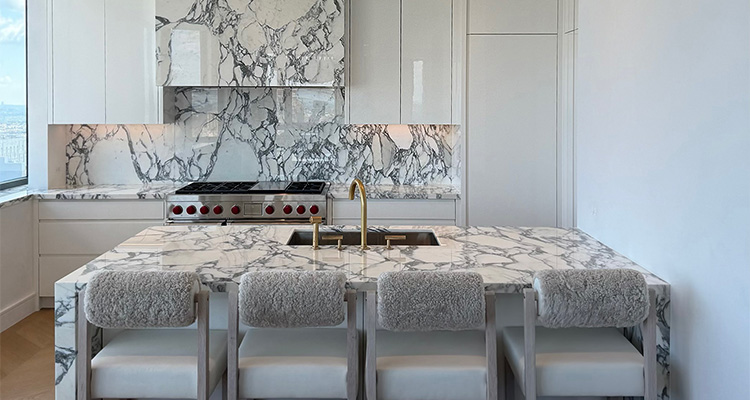
TC Browne & Co. reveals how its boutique approach delivers luxury renovations in Manhattan’s premier high-rise buildings
Before building luxury residences in some of Manhattan’s most exclusive buildings, Michael Browne worked on Wall Street. His longstanding love of carpentry ultimately brought him back to construction, and now, more than two decades later, he is the founder and general contractor of TC Browne & Co. (TC Browne). The firm took shape after Michael met Ted Chan, then a client, who had experienced his craftsmanship and approach firsthand. Although Ted did not come from a construction background, he had built and led his own business. Recognizing the potential in Michael’s work, the pair joined forces and established a company together.

Today, TC Browne specializes in high-rise condominium renovations across Manhattan, with a concentration in the city’s most demanding and affluent residential zip codes. The firm is experiencing one of its busiest periods in years. Modern Home Builders spoke with Michael; Kiki Ong, Director, Business Operations; and Shane Harris, Senior Project Manager, about the discipline required to renovate luxury residences in the heart of New York City.
Shane attributes part of the current demand to the post-pandemic return to New York and the renewed emphasis owners have placed on their homes. “After the initial move out of the city, people began returning and investing more in where they live,” he says. “Beyond that, renovation is cyclical: aging buildings and property sales continue to generate a steady flow of work.”
Kiki adds that demand tends to arrive in waves, with periods of heavy proposal activity followed by temporary pauses around major events. “Work often slows around elections and administration changes,” she explains. “Homeowners become cautious, but once that uncertainty passes, clients who have been waiting generally move forward. New York keeps going.”
Mastering complex conditions
For Michael, the defining challenge is that these are occupied buildings, not isolated construction sites. Also, the sheer population density in Manhattan creates traffic and parking issues, street closures, etc., which complicate deliveries and refuse removal. Once on site, service elevators must be booked and scheduled around other move-ins and move-outs in the building; working hours are often limited to 9 a.m. to 4 p.m.; some elevators close during lunch; and noisy work may not begin until 10 a.m. Dust containment is equally important. “Ventilation shafts run through entire buildings, so they must be carefully sealed and checked continually,” Michael says. “Maintaining containment is critical to protecting hallways and neighboring apartments.” Michael explains.
The work also requires constant coordination with building staff, property managers, and insurers, requirements that do not arise to the same degree in a private stand-alone house. High-rise work does offer practical advantages. “Once we are inside, the environment is basically climate controlled, so weather is no longer a factor,” Michael says. Around-the-clock building staff also reduces the risk of tools or materials being stolen or damaged.
Personal touch
Prewar buildings bring a different degree of uncertainty. Shane recalls a project at 1120 Park Avenue where, upon demolition, it was discovered that a corroded plumbing riser had rotted through to the apartment below, requiring the team to coordinate access and open the ceiling of an apartment that had itself recently been renovated. “You cannot fully determine what you’ll find behind the walls until you start investigating,” he says. Newer buildings typically have better documentation, because New York’s filing requirements have become stricter over time. In older properties, hazardous materials can create significant delays. “If we open a wall and discover asbestos, the filing and approval process through the Department of Environmental Protection can take months before abatement begins,” Michael explains.
In a market that includes much larger contractors, TC Browne has deliberately remained boutique. Kiki describes the firm as offering “the best of both worlds”: the organizational discipline, technical resources and insurance capacity of a larger contractor, without layers of management separating the client from the company’s principals. Michael spends most of his time in the field and remains involved in every project. His problem-solving ability and exacting eye for quality set the tone for the firm. “He can spot something an eighth of an inch out of alignment from across a room,” Kiki says. “That degree of personal involvement is difficult to replicate at a large firm.”
Exceptional customer experience
Shane, who previously worked for larger firms, sees the same advantage in communication. At TC Browne, the project team works directly with clients, designers, architects, subcontractors, and engineers, making coordination faster and more accountable. Every Friday, clients receive a detailed report covering completed work, deliveries, site conditions, and the decisions or information still required from the architect and owner. “Clients should never have to chase their contractor for information we should already be providing,” Shane says. The team also conducts an internal project review each Friday, ensuring that everybody knows exactly what stage each project is at.
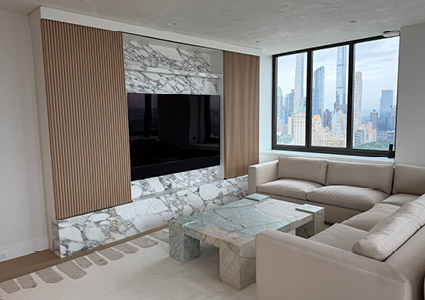
With the average apartment TC Browne works on being valued in the multi-millions, all client expectations are exacting, regardless of their project budget. Michael explains that the more meaningful difference lies in the client’s priorities and working style. “Everybody is different,” he says. “What is critically important to one client may matter far less to another. We must understand each client’s priorities, concerns, and previous experiences. That is how we earn trust and maintain it throughout the project.” Shane adds that trust depends on accountability. “If I do not have an immediate answer, I give the client a specific time by which I will respond, and then I honor that commitment.”
TC Browne also participated in this year’s Kips Bay Decorator Show House in Greenwich Village. The annual event benefits the Kips Bay Boys & Girls Club and brings leading interior designers together to transform a Manhattan townhome, raising funds for the club’s after-school programs. “We built two rooms for two different designers,” Kiki says. “It was rewarding to contribute our work to an event that supports children and the wider community.”
Looking ahead, Michael expects demand for high-end Manhattan renovations to remain strong, while the firm becomes more selective about the projects it undertakes. “We would rather take on fewer, larger projects and commit more of our staff to each one,” he says. The goal is to concentrate on approximately three major renovations at a time rather than four or five. Shane expects the work itself to become more sophisticated and highly customized, with greater integration of home automation and increasingly complex design. “TC Browne is structured to adapt to that level of complexity,” he concludes.