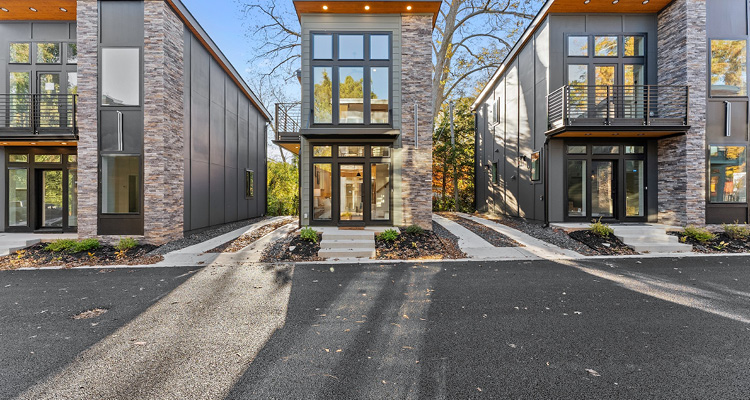
Raven Residential crafts thoughtful, design-led infill homes while exploring smaller, more attainable housing solutions
Specializing in commercial and residential infill projects, Raven Residential Group (Raven Residential) is a boutique home builder working across some of the American South’s most scenic and historically significant cities. With a focus on enhancing communities and creating better living opportunities in urban and suburban areas, the company brings a considered, design-led approach to every property. Brian Odom, Partner and General Manager, shares exclusive insights into its latest projects.
“Raven Residential was founded in 2016 as a partnership between myself and my father, Dave, who has spent most of his adult life in construction and development. I started out right after school, working for an engineering firm he had a relationship with for about two years. This was at the peak of the market crash and like a lot of people at the time, I was laid off. I stepped away from the industry entirely, going on to work for a shipping company and teach sailing for several years, fairly certain I would probably never re-turn to construction,” he opens.
“Around 2014, I changed my mind. I was living in Charleston at the time, and my dad was splitting his time between projects in Charleston and Atlanta. I started helping him with some of those, and after a couple of years working together, we decided to launch our own entity together, Raven Residential. I eventually re-located from Charleston to Greenville, South Carolina, which is where we are based today. We started with two infill houses in Greenville while I continued helping with his projects in Atlanta, and the business has grown from there. The majority of our work is now concentrated in North Georgia.”
Considered creativity
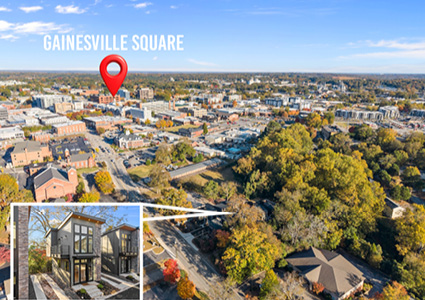
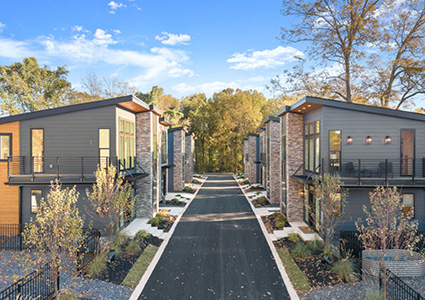
For the past year and a half, the father and son duo has been exploring ways to make housing more attainable. While they cannot make them substantially less expensive to build, they realized they could reduce the footprint, thereby making them more affordable. “We have two communities under construction in Gainesville where we are building what we call micro homes, ranging from just under 600 square feet to 1100 square feet. They are all detached single-family homes, but very compact, small houses. It is a model I think we will see more of across the country, as to make housing more attainable, people are going to need to trade square footage for affordability. Villa Nova, the first community, is now complete and has come out really well. The second, Trailside Commons, differs in style by embracing a more tradition-al-looking design. Additionally, rather than individual driveways between units, it features a central parking area,” he continues.
Through their collaboration across a variety of projects, Brian and Dave have developed a cohesive design process, approaching each home as a team from the very first site visit. When they look at a piece of land, they consider how a house would sit within it and what the surrounding environment calls for, whether it is a more modern or a more traditional product. At Villa Nova, for instance, mature trees on either side of the property led Brian to conclude that a modern design with darker colors would complement the canopy well. In contrast, Trailside Commons is a wider and more open space backing onto a city greenway better suited to a traditional aesthetic. Every plot is different, and every location has its own character that guides Raven Residential’s decision.
From the day they break ground, Brian and Dave know that a home is unlikely to sell for at least a year to eighteen months, given how long it takes to go through all the planning, site work and construction. That means the team must make considered predictions about what buyers will want at least a year from the time construction begins.
As Raven Residential primarily funds its projects privately, there is also the added responsibility of showing its funding partners something that is genuinely exciting; a design and a location that justifies their investment.
Building better, not bigger
Both projects capture Raven Residential’s home building ethos, which is all about deliberate choices to create properties that last. That philosophy extends to how Brian sees the next five years unfolding. “My father is transitioning towards semi-retirement. Though I suspect he will never stop working entirely, he has expressed a desire to step back from full-time work. Over the next five years, I expect he will become progressively less involved, and I will take on more of the entitlement and development side of the business. That will also mean finding someone to fill my current role. Lately, my sister has been helping us in a few areas and we’re looking to get her more involved over time.
“We love being a small builder and I particularly enjoy the design-build aspect of our work, but I do worry that small builders will find it increasingly difficult to compete outside of custom homes. We’re fortunate to have a great team of vendors and subcontractors to make our vision possible. But the margins in homebuilding are notoriously thin, and as the builder, we are always the last to get paid. There is significant risk in spending years on small developments only to find there is no money left at the end, or worse, that you owe someone money. For us, I think the path forward is finding the right infill projects where we can build enough units to make the numbers work without sacrificing the aspects that make us unique, or trying to compete with larger builders on their terms,” Brian ends.
In a market that rewards scale, Raven Residential has no interest in being the biggest builder in North Georgia. Its success and edge come from staying small, selective and building homes worth being proud of.