New York funds factory-built homes to close the starter home price gap
Subscribe to our free newsletter today to keep up to date with the latest homebuilding news.
The Rochester Land Bank Corporation plans to place 15 factory-built, single-family homes on vacant lots in the city’s Upper Falls neighborhood, using $4,537,500 awarded through New York State’s MOVE-IN NY program. The award was announced by Gov. Kathy Hochul on Oct. 23 as part of a final 2026 funding round worth nearly $20 million for 61 homes across 4 counties.
Under the plan, the land bank will contract with Champion Homes to build the houses, which are expected to cost just over $300,000 each to develop, according to WXXI News. They will be sold for $100,000 to $120,000 to buyers earning 60% to 80% of the area median income, with state subsidies covering the gap between what each home costs to build and what its buyer pays.
It is the city’s second and largest factory-built housing development, and it arrives as builders across the US struggle to produce entry-level homes at prices that first-time buyers on moderate incomes can afford. The plan places 9 houses on Almira Street, 3 on Galusha Street, 2 on Oakman Street, and 1 on Lowell Street.
Factory-built homes are narrowing the starter home cost gap
Rochester’s numbers explain why public agencies are paying closer attention to factory-built housing. The city’s Buy the Block program, which has produced 56 site-built homes, 32 in the southwest of the city and 24 in the northeast, has cost upwards of $350,000 per house to build. The Upper Falls homes are expected to come in about $50,000 lower per house, which WXXI reports leaves a smaller subsidy gap than comparable city projects.
At the state level, the governor’s office puts the cost of building a typical small single-family home in New York at upwards of $450,000, a figure that sits far beyond what households earning below the area median can borrow. A subsidy of more than $180,000 per home is still substantial, but every dollar saved in construction allows the same public funding to reach more buyers.
Speed is the other advantage, because factory-built homes can be erected more quickly than conventional construction. Much of the work happens off site, which reduces the time a lot sits under construction and the exposure to weather delays, labor shortages, and rising financing costs that can push up the final price of a site-built home.
CrossMod homes are designed to look and finance like site-built houses
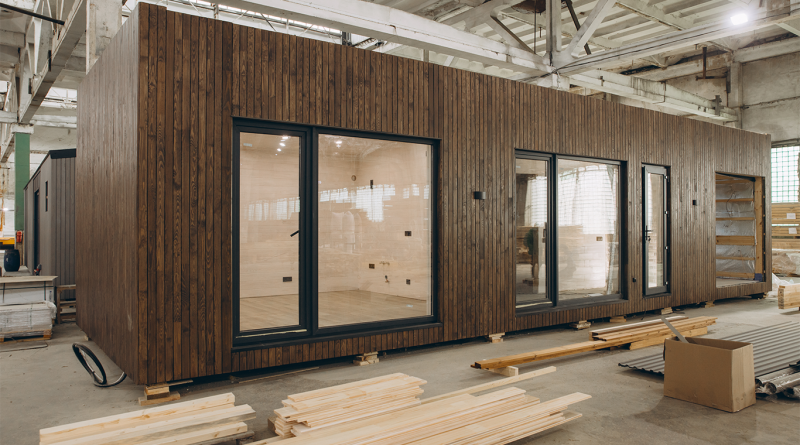
The homes funded through MOVE-IN NY are a type of prefabricated house known as CrossMod, which New York State Homes and Community Renewal, the agency that runs the program, describes as resembling traditionally built single-family homes. WXXI reports that the Rochester houses will be built to look like standard wood-frame homes, a design choice that matters in established neighborhoods where residents and planners may resist housing that looks out of place on the street.
Each home is built to HUD’s Manufactured Home Construction and Safety Standards Code and to Fannie Mae and Freddie Mac design guidelines. Meeting those guidelines allows buyers to finance the homes with conventional mortgages.
That financing detail is central to whether factory-built housing can compete in the starter home market. A house that costs less to build but is harder or more expensive to finance offers little advantage to a first-time buyer, while a CrossMod home that qualifies for a standard mortgage can be sold and valued much like any other single-family house.
The program also reflects a wider policy shift toward factory-built housing at the federal level, where recent legislation removed the long-standing requirement for manufactured homes to be built on a permanent chassis and HUD has set out plans to update its construction code for chassis-free designs.
Rochester is still learning how factory-built homes fit city neighborhoods
City officials are treating the project as a test of what factory-built housing can achieve in an urban setting. Erik Frisch, commissioner of Rochester’s Department of Neighborhoods and Business Development, told WXXI there is “a learning curve here” because so few factory-built homes have been placed in New York’s urban centers, and he described the program as an experiment in increasing homeownership.
The city’s own experience supports that caution, since Rochester’s first modular project, which proposed 9 houses on 7 lots in Marketview Heights to be developed by Cook Properties, started last year and is still in development.
MOVE-IN NY has awarded more than $80 million to date, creating homeownership opportunities for 250 households, and is backed by $50 million from the state’s 2026 budget and a further $100 million from its 2027 budget. Hochul said the program is “bringing modern, affordable single-family homes to the market more quickly and in more regions than ever before.”
Whether that promise holds in Rochester will depend on how quickly the Upper Falls homes move from factory to finished lot, how their final costs compare with the projected figures, and whether buyers and neighbors accept factory-built houses as an ordinary part of the city’s housing stock.
Source
WXXI News