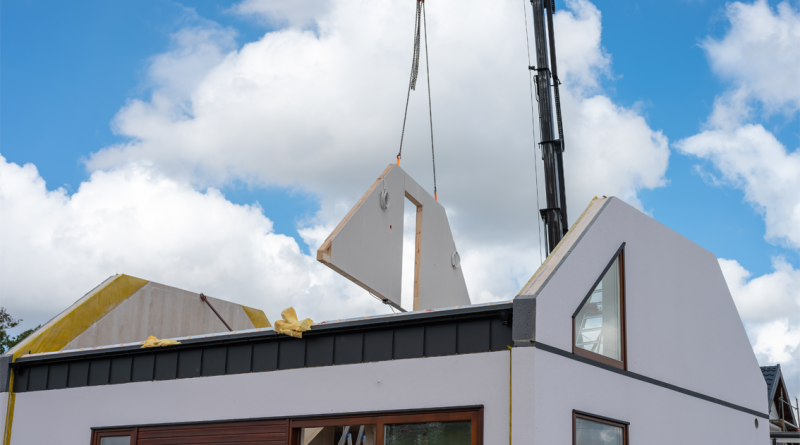
Modular housing is gaining momentum as the housing crisis deepens
Subscribe to our free newsletter today to keep up to date with the latest homebuilding news.
Housing shortages have become one of the defining economic challenges of the decade. Demand continues to outpace supply across many developed markets, while labor shortages, rising construction costs and planning delays have exposed the limits of traditional building methods. Against that backdrop, factory-built housing is attracting renewed attention, not simply as an alternative construction technique but as a practical way to increase housing supply at scale.
For years, modular construction struggled to overcome the perception that it was suited only to temporary accommodation or niche residential developments. That view is changing. Manufacturers, developers, policymakers and investors increasingly see factory production as an opportunity to improve productivity in an industry that has historically lagged other sectors in adopting industrialized processes.
The discussion has also expanded beyond construction. New financing models, retail investment opportunities and government support are positioning modular housing as part of a broader strategy to improve affordability while accelerating housing delivery.
The housing shortage is exposing the limits of traditional construction
Housing markets across North America, Australia and Europe continue to face significant supply constraints. While higher interest rates have reduced demand in some regions, they have also discouraged new development as financing costs increase and builders face greater uncertainty.
In the US, Realtor.com estimates the national housing supply gap exceeded four million homes in 2025, highlighting the scale of the structural imbalance between supply and demand. The shortage has delayed home ownership for many younger households while placing sustained pressure on affordability.
Builders also face an increasingly severe labor shortage. The National Association of Home Builders estimates the skills gap costs the industry billions of dollars every year while preventing thousands of new homes from reaching the market.
Traditional site-built construction remains dependent on weather conditions, fragmented subcontractor networks and sequential project schedules. These constraints make it difficult to increase production quickly, even when market demand is strong.
Factory-built construction addresses many of these challenges by shifting much of the building process into controlled manufacturing environments. Standardized production reduces delays, improves quality control and allows multiple construction stages to proceed simultaneously rather than one after another.
Modular construction is becoming a manufacturing story
The greatest advantage of modular construction may not be lower costs. It may be higher productivity. McKinsey & Company has reported that modular construction can reduce labor requirements by as much as 40% while shortening project delivery by up to 50% when projects are designed specifically for offsite manufacturing. Those gains depend on disciplined planning, standardized designs and sufficient production volume, but they demonstrate why industrialized construction continues to attract attention.
Rather than assembling every component on a construction site, manufacturers produce complete sections of buildings inside factories before transporting them for final installation. This process reduces weather-related delays, minimizes material waste and creates more predictable production schedules.
Companies such as BOXABL have attracted attention by applying manufacturing principles commonly associated with the automotive sector to residential housing. Their objective is not simply to build homes faster but to establish scalable production systems capable of delivering thousands of housing units each year.
The wider industry is moving in the same direction. Digital design, automation and advanced manufacturing technologies are helping modular builders improve consistency while reducing dependence on scarce skilled labor.
Investment models are evolving alongside construction
Innovation is extending beyond the factory floor. Built Offsite recently highlighted Kinexx Modular Construction’s crowdfunding initiative, allowing individuals to invest from as little as US$500. While still an emerging model, it reflects growing interest in making housing investment accessible to retail investors rather than limiting participation to institutional capital.
This approach mirrors broader trends across real estate, where fractional ownership and digital investment platforms continue to expand. If modular housing companies can consistently deliver predictable manufacturing output and reliable project execution, they may attract a wider pool of investors seeking exposure to residential development without purchasing property directly.
Access to capital remains one of the industry’s biggest challenges. Factory production requires substantial upfront investment in manufacturing facilities, automation and equipment before significant revenue is generated. Alternative financing models could help overcome this barrier while supporting long-term expansion.
Policy support will determine whether modular reaches scale
Government policy continues to shape outcomes through planning regulations, certification standards, procurement practices and building approvals. Without regulatory systems designed to accommodate factory-built housing, even efficient manufacturers face barriers to growth.
Australia has already begun moving in this direction through an A$54 million package supporting prefabrication and modular construction. The initiative includes matched funding for manufacturers alongside the development of a national certification framework intended to simplify approvals and improve industry confidence.
Other countries are considering similar measures as governments search for practical responses to persistent housing shortages. Faster approvals, consistent regulations and procurement reform could significantly improve the commercial viability of modular construction.
Modular construction is unlikely to replace traditional building methods entirely. Instead, it is becoming an increasingly important part of a broader housing strategy. As supply shortages continue and productivity remains a challenge, the industry’s future may depend less on building homes one site at a time and more on applying manufacturing principles that have transformed other industries for decades. Factory-built housing is no longer competing to prove it is an alternative. It is increasingly positioning itself as part of the mainstream solution.
Source:
Business Insider Markets