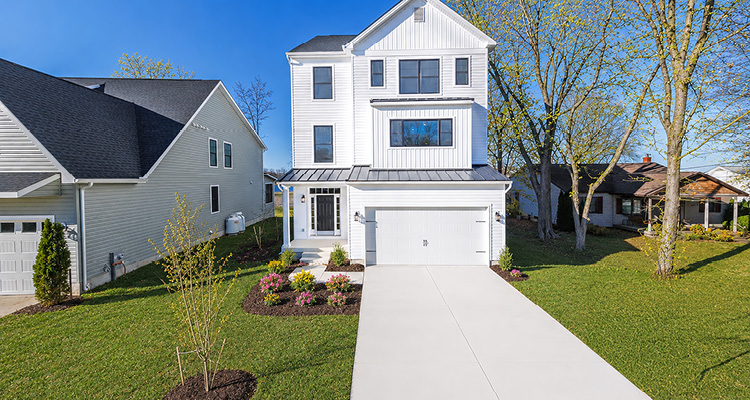
Learn about Lacrosse Homes’ latest project, which will double the size of the town it sits in
Established in 1994 by Lindsay Dixon, current Owner, Lacrosse is a residential home builder constructing anywhere from 20 to 50 homes a year, including townhomes and single-family homes. We sit with Bruce Orr, President, to learn more about the company’s current projects and ambitions. Before becoming such a driving force at Lacrosse, Bruce had a rather unconventional career path that eventually led him into home building.
“I took a fairly unique route into this industry where I went into accounting right after completing college, working for public accounting firms for a number of years. About 25 years ago, I made the transition into home building. My oldest brother was already in the industry, and through that connection I took a position with Pulte Homes, a national builder, where I worked for around eight years. I started out as a salesperson and worked my way up through the ranks to become Vice President of Sales and Marketing. When the division I was working for was sold, I moved across to the private entity that acquired it, working with them for about five years until they transitioned away from home building entirely into land development. That prompted me to move from Long Island to Delaware, where I worked for another national builder, K. Hovnanian, for around a year. The opportunity with Lacrosse came up shortly after, and a more regional builder felt like a better fit for where I was in my career at that time. I joined as Vice President of Sales and Marketing before being promoted to President of the company about a year ago,” he reveals
As a semi-custom builder, Lacrosse completes around four or five purely custom homes a year. Bruce tells us more about the kind of projects the company specializes in. “One of the key differences between us and the large national builders is that we can make structural or functional adjustments at our customers’ request, working with our architect to supply exactly what potential buyers want. That gives us a bit of a niche, allowing far more customization than most of our competitors offer. Over the last six years, our gross revenue has fluctuated between roughly $10 million and $20 million, depending on market conditions. For around a dozen years, we focused specifically on spot lot development, which involves buying individual lots and building homes on them, rather than operating as a community-based builder. Now we have transitioned back towards more community-based work, with three communities opening up and one ten-home subdivision currently underway. We also operate around 60 rental properties, building single-family and town houses specifically for rental, with 54 more rental homes starting in the next year or so. Our ultimate goal is to reach around 150 rentals. Alongside that, we offer property management services, and we are now opening up a new arm of the business focused on remodeling work as well,” he continues.
Major developments
Working on 20-to-30 builds a year across a range of locations, including waterfront properties, Lacrosse has had to remain consistent while adapting to the very different challenges each project presents; a balance that keeps the team on their toes. Much of that challenge has historically come from the spot lot model, where each piece of property the company purchases is unique, meaning every home requires its own approach to permitting and building. The shift towards community-based development changes that considerably, allowing the company to follow a more consistent process. Starting a home, getting it built, securing the certificate of occupancy and getting buyers into their homes is much easier when building one house after another rather than treating each lot as its own distinct challenge.
“That transition puts less burden on our staff, because time is everything in this business,” Bruce explains. “The longer it takes to get a house built and delivered, the more it costs us. There are real efficiencies to be found in traditional community-based development compared to spot lot work. We will continue doing spot lots, because it is a niche we have become really good at, and we have that process down well. In fact, we tend to beat the competition there simply due to having more experience handling the specific challenges that come with that kind of development. However, our broader focus going forward is on transitioning towards a more community-oriented business model.”
In line with this shift, Lacross has already got several major developments currently underway. The company is about to break ground on a project called Foxx Farms, which has been in the works for nearly three years and is now in its final engineering stages. “We hope to be moving dirt there within the next two months. Land development work will likely take a good six months before we can start putting houses in the ground. The project comprises 247 homes, a mix of single-family and town homes, and it will literally double the size of the town it is located in, about 20 minutes south of the Delaware border. For people working in northern Maryland or southern and central Delaware, it offers a strong commute, and price points in that area tend to be more affordable than they are further north or south, which we hope will attract people to the community,” Bruce elaborates.
For this project, Lacrosse is partnering with national builder Ryan Homes, who is going to purchase and develop single-family lots from the company, and potentially some of the town home products as well. The partnership is expected to create a useful point of differentiation, as Lacrosse will not necessarily be competing for the same buyers, which is particularly exciting for Bruce and the company itself. Just north of Foxx Farm, Lacrosse is also working on another community in Millington, around a few years out, encompassing 700+ homes.
“We will partner with other builders on that project too, and it will be a diversified product encompassing single-family and town homes, with some active adult sections, and there may even be a commercial element to it. This project is particularly exciting to us, because it really represents our transition back into more community-based developments, much like we did years ago. Beyond that, we are also working on a project in Denton, Maryland, comprising 100 homes, 60 single-family and 40 town homes, which we hope to have up and running within the next year and a half. That one is still in the land development phase.”
While Lacrosse’s pipeline stretches a decade out, what drives it is knowing exactly when to specialize and when to scale.