Hail in 16 States, Hurricanes in None: Why 2026 Storm Damage Doesn’t Match Your Weather Expectations
A builder walks a nearly finished project, weeks from handoff, when hail strikes overnight. The roof passes a visual inspection, but three months later, leaks appear in the new owner’s home, triggering insurance disputes and warranty claims while referrals dry up. The difference between this scenario and a clean resolution often comes down to the speed and expertise of the roofing partner a builder chooses.
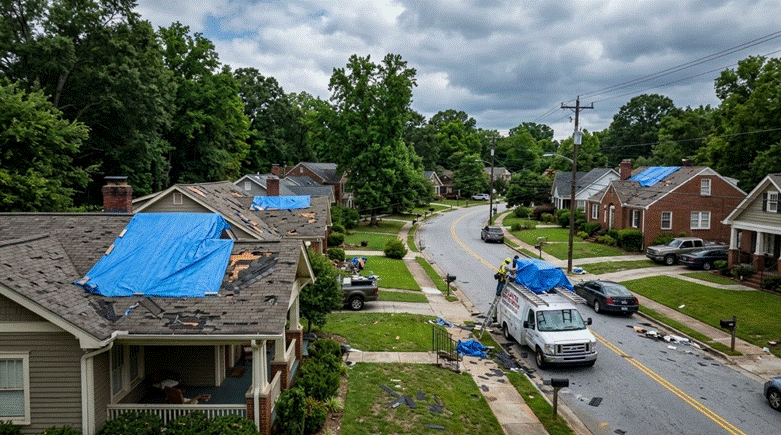
This scenario isn’t hypothetical. Dominick Fraser, owner of Fraser Roofing, a Top 100 Roofing Contractors company (2024) and CertainTeed ShingleMaster PREMIER contractor serving Georgia, South Carolina and North Carolina since 2009, saw exactly this pattern during March 2026’s hail sequences. In the two weeks following the storms, Fraser Roofing conducted post-storm inspections on recently completed homes across its service area. “We inspected multiple properties where homeowners thought everything looked fine from the ground,” Fraser notes. “But the majority of roofs in the direct storm path showed impact damage that wouldn’t be visible without getting crews up there with proper equipment. For builders, the difference between addressing this damage immediately versus discovering it through a homeowner complaint six months later is the difference between a quick insurance claim and a reputation problem.”
The 2026 Severe Storm Paradox
The construction industry entered 2026 expecting a quiet hurricane season, and forecasts have proven accurate. According to Verisk, “Average residential roof replacement costs reached $17,631 in 2025, with repair costs averaging $4,699.” The disconnect stems from severe hail events that damaged more than 20% of roofs across 16 states during the first quarter alone.
These storms struck regions that historically experienced moderate hail activity, and while fewer tropical systems formed, those that did were unprecedented in their destructive power. Increasing roof losses now occur independently of traditional storm-volume metrics, changing how builders assess weather-related project risk.
The Shifting Insurance Landscape and Its Impact on Builders
Federal policy changes compounded the storm damage problem in 2026, when new regulations ended insurers’ obligation to cover full replacement costs. Many carriers shifted toward Actual Cash Value policies, leaving homeowners responsible for depreciation gaps.
These coverage gaps create friction even for projects delivered with proper installations. When storm damage strikes and insurers shift roof-replacement costs to homeowners, those homeowners often turn their frustration toward the builder, questioning material choices or installation quality, even when the execution is flawless.
How Unseen Hail Damage Creates Business Risk
Hail damage remains invisible from ground level, and a roof may appear intact immediately after a storm while the impact points weaken shingle integrity beneath the surface. In fact, according to Dominick Fraser, company owner of Fraser Roofing, “Even small impacts can crack the protective surface of standard shingles. Those weak spots collect moisture during the next rain, and that moisture slowly breaks down the layers that keep water out of your attic.”
Contractors across the Midwest reported unprecedented workloads after spring 2026 hail events, creating a busy start to storm season that extended well beyond typical peak periods.
Roofing Contractor noted, “While damage estimates are in under initial review, they’re already expected to soar into the tens of millions of dollars in the upper Midwest.” Multiple storm rounds compounded cumulative damage on properties, requiring more extensive repairs.
When “monster” hail pounds Midwest communities, the stones can reach tennis-ball size or larger. Builders working on new construction or renovation projects face a critical window: document and address damage immediately, or risk having undiscovered problems become warranty claims after project completion.
Fortifying Projects with Resilient Construction Standards
Forward-thinking builders are incorporating higher resilience standards from project inception, and the Insurance Institute for Business & Home Safety (IBHS) established the FORTIFIED Roof designation as the industry benchmark for this approach. Properties built to these recommendations demonstrate better performance during severe weather.
According to IBHS, “FORTIFIED program has set the benchmark for beyond-code construction and re-roofing, designed to reduce storm damage by strengthening areas of homes, commercial buildings and multifamily properties.” The designation requires sealed roof deck, ring-shank nails, enhanced edge protection and impact-rated covering materials. While these upgrades add up front costs, they reduce long-term exposure by minimizing callback risk and warranty claims.
Building Resilience with Proactive Storm Partners
Material standards and construction techniques form the foundation of storm resilience, but the roofing contractor relationship determines how well a builder weathers the actual crisis. Response speed and documentation quality separate minor disruptions from major business problems when hail strikes a project.
The Critical Role of Same-Day Damage Inspections
Immediate inspection capability stops small problems from escalating by identifying hidden damage before moisture intrusion begins, documenting conditions for insurance purposes and establishing a clear repair timeline. Builders who partner with roofing contractors offering rapid response protect their project schedules and maintain client confidence.
The inspection reveals damage invisible to untrained observers, such as compromised granule coverage, fractured mat integrity and seal failures that ground-level visual checks miss entirely. Professional inspectors create defensible documentation, essential when insurance adjusters review claims weeks later. Understanding how home insurance covers roofs becomes essential knowledge for builders who want to advise clients accurately during material selection.
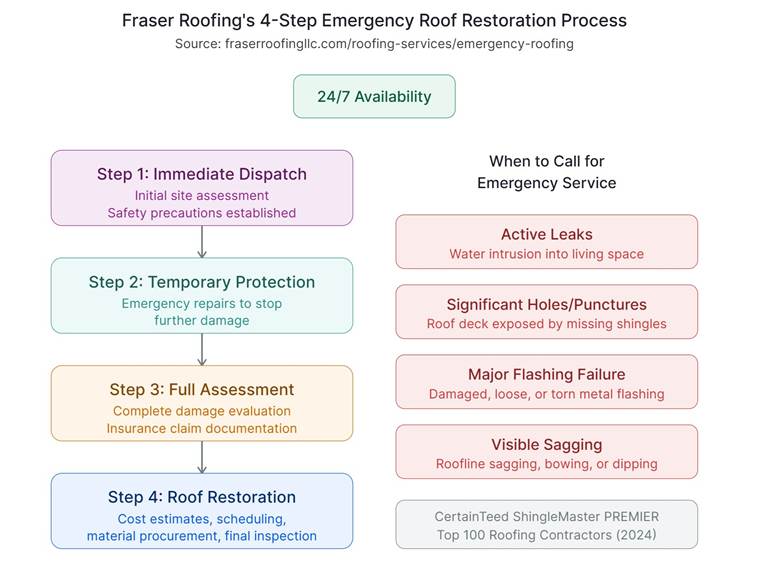
Established roofing contractors have begun formalizing emergency response protocols to meet this demand. Fraser Roofing, for example, operates a 24/7 emergency response team across its three-state service area. “We structured our emergency process into four specific steps,” Fraser explains. “Immediate dispatch and site safety assessment comes first, followed by temporary protection to stop further damage. Then we conduct the full assessment and prepare insurance documentation. The final step is the actual restoration work — cost estimates, scheduling, material procurement and final inspection. Having this formal process documented means builders know exactly what to expect when they call us after a storm hits one of their projects.”
This level of operational clarity matters particularly when builders face compressed timelines and anxious homeowners following storm events.
Choosing Certified Partners for Storm-Resistant Materials
According to Sika, “The average roof can last anywhere from 15-30 years, whereas the average building lasts between 50-100 years – meaning that every building will need at least one roof replacement or repair in its lifetime.” Impact-resistant materials and proper installation are the primary defense against windstorm damage, and using quality repair materials appropriate for the climate zone separates adequate work from resilient construction.
Manufacturer certifications separate commodity roofing contractors from premium partners. Fraser Roofing earned CertainTeed’s ShingleMaster PREMIER designation in 2018, a credential that requires demonstrated installation expertise, sustained quality metrics and ongoing technical training. The credential represents CertainTeed’s highest contractor tier, with fewer than 1% of roofing companies qualifying nationally.
“The PREMIER certification gives our clients and partners confidence that we’re installing their materials according to manufacturer specifications,” Fraser notes. “But the real value comes from the technical support network. When we encounter unusual substrate conditions or complex flashing details, we have direct access to CertainTeed’s engineering team. That expertise matters most on custom builds where every roof presents unique challenges.”
Navigating Insurance Claims Post-Storm
Roof Simple outlines how to file a roof claim to help advise clients appropriately. The company explains, “It’s not unusual for a homeowner to file one or two claims every 10 years or so.” Insurance claim success depends heavily on documentation quality and industry-standard communication.
Roofing contractors who specialize in storm response understand what adjusters need — photo documentation with scale references, itemized damage assessments using industry terminology and repair estimates that align with insurance company databases. These contractors identify damage that less experienced evaluators might overlook while ensuring the claim scope addresses all necessary repairs.
Fraser Roofing has built its reputation on helping homeowners navigate post-storm insurance claims, an expertise that matters to builders when their clients face storm damage on recently completed homes. “The insurance documentation process intimidates most homeowners,” Fraser explains. “We photograph every damaged area from multiple angles with measurement references visible in frame, and we document exactly what adjusters need to see — the damage extent, the surrounding context and the measurement data that drives their calculations. When builders’ clients work with contractors who understand this process, it reduces the friction that can spill back onto the builder’s reputation.
The company’s inspection teams carry professional equipment like moisture meters, infrared cameras and calibrated measurement tools, creating evidence packages that withstand scrutiny during the claim review process. For builders managing warranty obligations alongside insurance claims, this documentation protects against disputes about whether damage predated the storm event or resulted from installation defects.
Frequently Asked Questions
Here are the most commonly asked questions.
Can roofing companies provide a detailed estimate for an insurance company?
Professional roofing contractors provide insurance-grade estimates that include photo documentation, material specifications and labor breakdowns. The estimate details every component requiring replacement or repair, using line items that correspond to standard insurance claim formats.
How soon can roofing companies start the repair work?
Emergency response timelines vary significantly based on contractor capacity and the severity of the damage. Fraser Roofing operates a 24/7 emergency response team with immediate dispatch capability for storm-related damage. “When we receive emergency calls about storm damage, we prioritize getting our team on-site to assess the situation and prevent further damage,” Fraser explains. “Our first priority is always protecting the property — if there’s structural damage or active water intrusion, we deploy emergency tarping and temporary protection measures to stabilize the situation while we develop the comprehensive repair plan.”
Roofing contractors equipped for emergency response can typically provide temporary protection measures quickly to prevent additional damage, while comprehensive repairs are scheduled based on the scope of work, material availability and crew capacity. For builders working with roofing contractors, establishing relationships before emergencies occur often results in more responsive service when storm damage strikes active projects.
Is the inspection fee waived when hiring a roofing company for the repair?
Fee structures vary by contractor and company policy. Many roofing contractors apply inspection fees toward project costs when the client proceeds with recommended repairs, though builders should clarify this policy during initial partnership discussions.
Future-Proofing Businesses Against Evolving Climate Threats
The 2026 storm paradox represents more than a single year’s anomaly, as climate patterns continue to shift and decouple traditional weather forecasting from actual damage patterns. Builders who treat storm readiness as infrastructure rather than incident response position themselves for long-term success. Material selection, certified partnerships and rapid response capabilities now function as competitive differentiators in residential construction.
*Please note that this list includes sponsored content. Some of the companies, products, or services featured have entered into commercial agreements for placement. Sponsored placements do not necessarily reflect an endorsement and should be considered alongside other options in the marketplace.