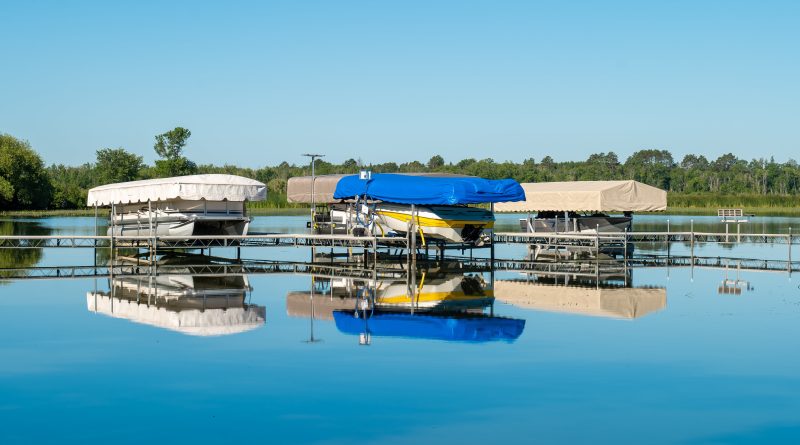
Comparing and Contrasting 5 Different Pontoon Boat Lifts
A pontoon left in the water all season can develop algae on its tubes and suffer wear from repeated dock contact. Builders planning waterfront homes must consider how the shoreline setup shapes a client’s boat use over the years.
Every shoreline brings different weight, depth, layout and power considerations, making the right choice highly site-dependent.
5 Different Lifts for Pontoon Boats
According to NMMA, pontoons accounted for more than one-third of the U.S. outboard-boat product mix in 2024, the largest share of any category. Boats left in the water can collect invasive species, and under Minnesota rules, docks and lifts must dry for 21 days before entering another lake or river. Caring for these vessels requires the right lifting equipment.
1. EZ Dock: Optimus FloatPort
The EZ Dock Optimus FloatPort allows a boat to drive onto the floating platform, raising it fully out of the water and requires no motors or hydraulics. Drive-on docking uses the boat’s propulsion, while the listed 30-foot customization option includes a bridge and winch to assist loading when additional pulling power is needed for large craft.
Key Features
- Capacity: Scaled for 16- to 30-foot pontoons and tritoons, with up to 6,840 pounds across three size options.
- Best fit: Fresh or salt water, since the floating design holds the boat at a constant height above water.
- Operation: Drive on and drive off, and the listed 30-foot configuration includes a bridge and a winch for loading assistance.
- Durability: Foam-free flotation chambers and corrosion-resistant materials are backed by a 10-year limited flotation warranty.
2. ShoreStation: Freestanding Pontoon Lifts
ShoreStation’s freestanding pontoon lifts rest on supports built from the lake bottom, with configurations available for two-tube pontoons and tritoons. Steep drop-offs or very deep water may push buyers toward floating designs instead.
Key Features
- Capacity: 3,000 to 10,000 pounds across three cradle options, with the log rack rated for tubes up to 29 inches in diameter.
- Best fit: Boat lifts for pontoon boats in 1-8 feet of water, making it suited to shallower bodies of water.
- Operation: A manual winch or solar DC hydraulics, which needs no electricity at the dock.
- Durability: Aluminum construction with stainless cables, a 15-year cable warranty and a history dating to 1959.
3. HydroHoist: UltraLift Floating Lifts
The HydroHoist’s UltraLift floating lifts flood to lower the lift and fill with air to raise it, so it rises and falls with a floating dock. It’s built primarily for freshwater use. This makes it a practical option for floating slips where water levels change throughout the season.
Key Features
- Capacity: 5,000 to 32,000 pounds for UltraLift, while the Shallow Water model is rated 5,000 to 9,000 pounds.
- Best fit: Floating U-shaped slips that include a shallow model operating in about 22 inches of water plus draft.
- Operation: Push-button air-assisted raising and lowering of the system.
- Durability: Polyethylene tanks with steel used above the waterline and made in the USA since 1964.
4. Sunstream: SunLift X
The Sunstream SunLift X pontoon models are set apart by a freestanding hydraulic design built for lakes with real seasonal swings. An adjustable lifting range is one of the primary reasons to choose them. That flexibility can help builders plan around changing shorelines without switching to a floating system.
Key Features
- Capacity: The SunLift X line runs 5,000 to 30,000 pounds, with PON-designated pontoon models.
- Best fit: A lifting range up to 6.5 feet, operating with as little as 7 inches under the keel or skeg.
- Operation: Hydraulic, with a battery charged by solar or AC power.
- Durability: Suited to fresh or salt water, but zinc anodes are required for nautical-based installations.
5. Hewitt Cantilever Pontoon Lifts
A pivoting frame on the Hewitt cantilever pontoon lift raises the cradle with fewer hardware components than hydraulic designs do, making it well-suited to smaller pontoons. The cited models top out at 3,600 pounds, well below many modern tritoons.
Key Features
- Capacity: 2,400-pound and 3,600-pound cantilever pontoon models.
- Best fit: An adjustable pontoon rack kit fitting a variety of tube layouts.
- Operation: A manual winch or a 12-volt or 110-volt motor with a remote.
- Durability: A 15-year conditional warranty on aluminum construction and welds.
Pontoon Lift and Port Comparison at a Glance
Side by side, the five designs differ in how they hold boats across various conditions.
| Company and Product | Design Type | How It Holds the Boat | Capacity Range (lb) | Best-Fit Water and Dock | Power |
| EZ Dock Optimus FloatPort | Floating drive-on port | The boat drives into the port | Up to 6,840 | Fresh or salt, floats with level | None, optional winch |
| ShoreStation freestanding lifts | Freestanding vertical lift | Cradle raised on legs | 3,000–10,000 | Water 1–8 ft deep | Manual winch or solar hydraulic |
| HydroHoist UltraLift | Floating lift | Air tanks raise the cradle | 5,000–32,000 | Floating slips, freshwater | Push-button air assist |
| Sunstream SunLift X | Freestanding hydraulic lift | Hydraulic cylinders raise the cradle | 5,000–30,000 | Fresh or salt, up to 4.5 ft swing | Solar- or AC-charged battery |
| Hewitt cantilever lifts | Cantilever lift | Pivoting frame levers cradle | 2,400–3,600 | Varied layouts via rack | Manual winch or 12V/110V motor |
Criteria Behind These Pontoon Lift Picks
These criteria helped identify companies with practical, well-supported lift equipment for pontoon owners and waterfront projects.
Selection points include:
- Pontoon-specific compatibility: Creates lift or port designs that support pontoon and tritoon tube layouts.
- Reliable capacity ratings: Provides clear weight limits so buyers can size equipment to a fully loaded boat.
- Durable marine-grade construction: Uses materials suited for long-term exposure to water, weather and dockside wear.
- Site adaptability: Offers options for different water depths, dock layouts and seasonal water-level changes.
- Safe, practical operation: Provides a clear operating method, such as drive-on access, manual winching, hydraulics or air-assisted lifting. Proper insulation prevents stray voltage from faulty wiring, which can cause electric shock or drowning.
Frequently Asked Questions
A few practical questions come up once a lift or port is on the shortlist.
Q: What kind of boat lift do I need for my pontoon?
A: The right lift or port depends on the fully loaded weight, water depth and fluctuation, dock layout, local rules and available power. Stable, shallow sites suit freestanding or cantilevered lifts, while fluctuating water levels favor floating designs.
Q: Can a boat lift go straight into a different lake?
A: Lifts can carry attached invasive species between water bodies, and Minnesota requires a 21-day dry period before installing them in a different lake or river.
Q: Are powered pontoon lifts safe around swimmers?
A: Faulty dock wiring can energize the water around a lift, so suitable protection helps reduce that risk on hydraulic and electric models. Non-powered options eliminate the need for dock wiring altogether.
Matching the Right Lift or Port to Each Pontoon
Builders must ensure capacity is sized to the pontoon’s fully loaded weight. The depth and fluctuation of water inform the choice between freestanding, cantilever and floating designs. Local rules and available utilities shape the final specs, so the right setup is the one built for the environment in which the pontoon will actually float.
*Please note that this list includes sponsored content. Some of the companies, products, or services featured have entered into commercial agreements for placement. Sponsored placements do not necessarily reflect an endorsement and should be considered alongside other options in the marketplace.