Callaway Builders balances cutting-edge sustainability, family-driven building principles, and long-standing relationships in Atlanta
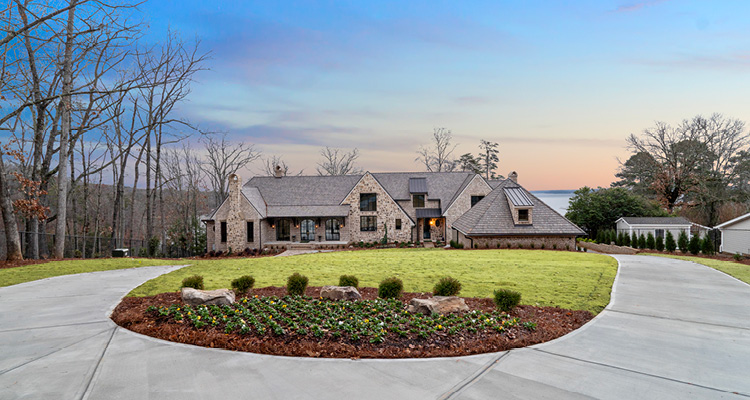
On the shores of Lake Lanier, just North of Atlanta, sits a home unlike any other Callaway Builders, Inc. (Callaway) has completed before. With ceilings soaring to 30 feet in places, flooring made from reclaimed historic wood, and custom beams filling every room, the project took a year of planning before construction even began. “The Lake Lanier project was incredibly unique – we developed the plans for homeowners who were involved throughout, and products were being shipped from overseas,” elaborates Curran Watters, President of Callaway. “We dealt with every aspect of that home, and it was outstanding.”
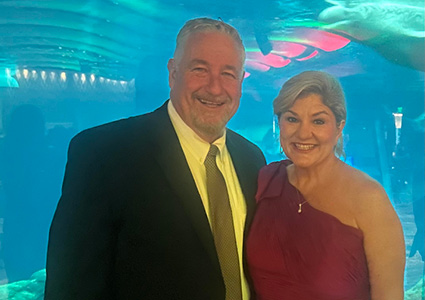
With four decades of experience in the building industry, Curran founded Callaway 21 years ago and his involvement with the Atlanta Home Builders Association has run parallel with his career. This collaboration includes serving on multiple boards and, most recently, a term as president of the North Fulton County Chapter of the HBA. His leadership hasn’t been confined to committee meetings – it feeds directly into how Callaway operates daily. “I’ve always taken an active role in the day-to-day management of the company,” Curran says. “At Callaway, we approach every project as if we were building it for friends and family.”
Building with integrity
This philosophy is rooted in Curran’s own childhood experience and the company’s mission; centering on family, tradition, quality, and integrity. “I grew up in the South, and in Mobile, Alabama, where I’m from, there are many historic homes,” he reflects. “I think back to those homes – the unique qualities I saw in them – and strive to bring that into what we’re building for our clients. When we are helping people design and build their homes, I always consider how that home will become a part of history in the years to come – how will it look to someone else in the future?” Along with these fundamental values, the firm is constantly exploring innovation within the industry, aiming to incorporate new products and processes into its construction. “The quality we instill into each home represents who we are, and the integrity my dad taught my brothers, my sisters, and me. He always stood proudly behind the work he did. I bring that same ethos into Callaway, and we try to live up to it every day.”
Prioritizing sustainability
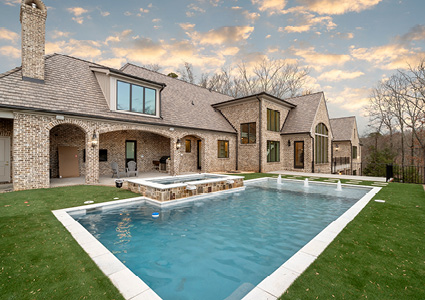
Being an EarthCraft builder, the company utilizes multiple cutting-edge, green practices and materials designed to maximize benefits without going drastically over-budget for its customers. “Throughout the whole design-build process, we consult with our clients and discuss sustainable materials, examining how they can benefit homeowners and improve energy savings.” This comes down to how Callaway seals the envelope of the house. “We apply EarthCraft standards on every home,” explains Curran. “Not only is it better for the environment, that benefit means the customer gets a more energy efficient home and equals significant cost savings for them in the long-term.” He reveals that product innovation has had the biggest effect on the business, offering home insulation by way of an example. “Insulation has changed enormously over the past several years, and that’s had a huge impact. It affects how the HVAC system performs, which correlates directly with how comfortable the homeowner feels – whether it’s a hot or cold day.” Callaway works closely with its HVAC contractor to examine every possible aspect of the home before construction begins. “They carry out Manual S and Manual J calculations on the build, examining the positioning, the windows, the doors, and the other materials involved,” he adds.
In terms of capabilities, the firm builds both new homes and undertakes major remodels. Where new builds allow for copious improvements to any part of the project, remodels present some separate challenges. “Clients can explore all sorts of possibilities for their custom home and decide what meets their personal requirements,” notes Curran. “Today, this often includes new technology available for controlling systems and such, but with remodels we are mostly dealing with older components and building practices.” One of the main challenges with remodeling is the fact that clients are usually living in the property while construction is taking place. “Practices that work on a new construction site may not fit an occupied home,” he tells us. “Customers are on site watching it develop, and our process isn’t always well understood, so educating them on that is a priority from the start.”
Callaway’s approach is shaped as much by who sits at the drawing board as who’s on site. With two in-house designers working alongside the build team, the company avoids miscommunication that can quite easily occur in traditional design-bid-build models. “Our designers make the process much smoother, not just for our customers but also for us,” highlights Curran. “They truly help us do a better job of building!” Having several perspectives in the room means more tailored solutions and ideas that homeowners may not have considered on their own.
Personal attention
As President, Curran positions himself as the direct point of contact for every client, backed by weekly project updates and, when needed, face-to-face meetings. Communication is vital to Callaway success – whether with clients, trade partners or subcontractors, some of whom have worked alongside Curran personally for over 30 years. “It’s all about those relationships,” he emphasizes. “If issues ever arise on a build, which they inevitably do, they can always help us to improve and adapt. Your builder is only as good as his partners and his communication between them and with the homeowner. “
Looking ahead, Curran hopes to see local government lend more support to small, family-run builders, and other businesses, who are competing against national developers, yet his clearest ambition lies closer to home: his son, currently studying construction management, joining the business and carrying it into a new generation. “Callaway is a family-run business,” he ends. “And I genuinely want it, and our projects, to stand the test of time.”